
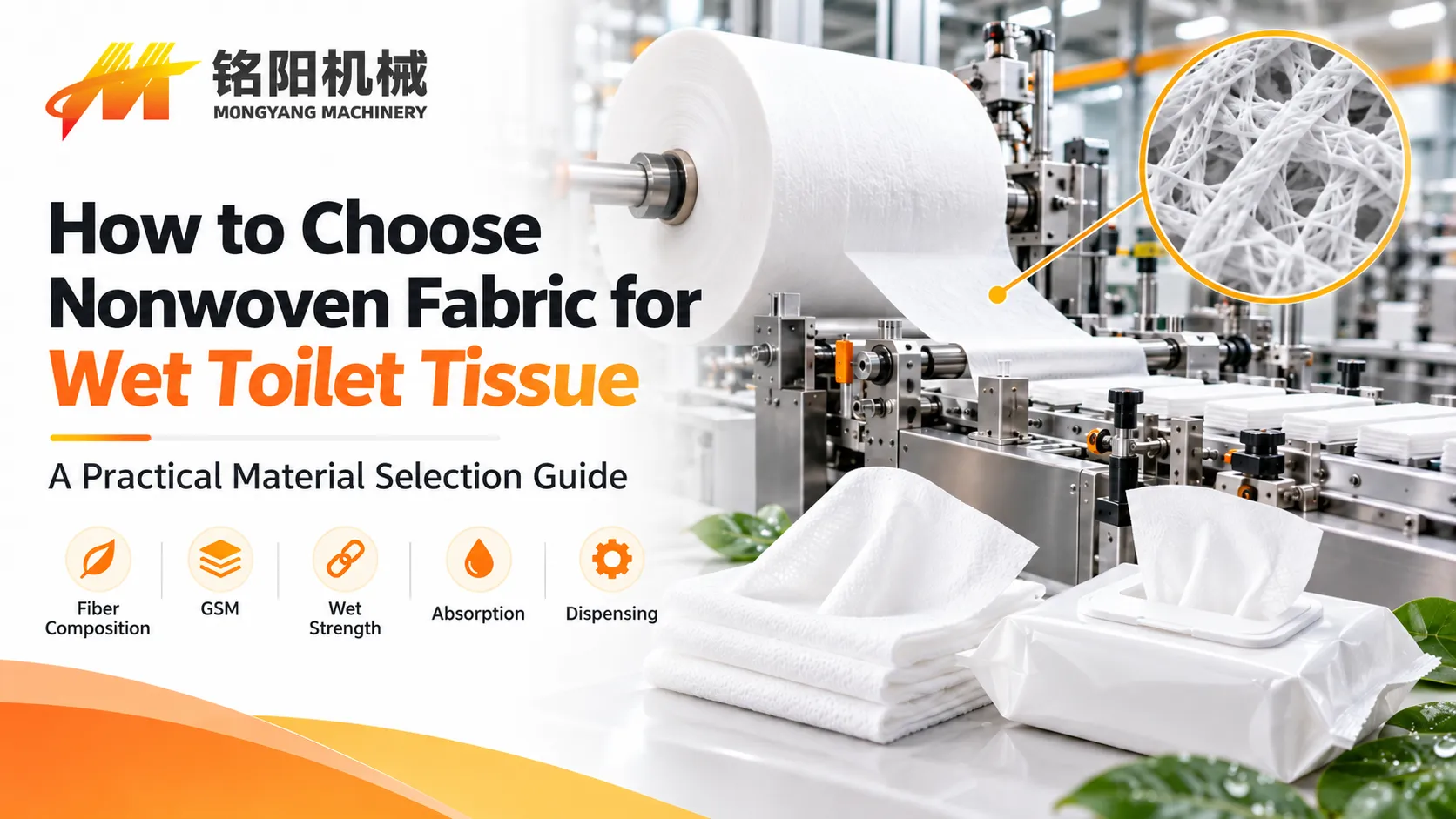
The right nonwoven fabric for wet toilet tissue should provide sufficient wet strength, absorb liquid effectively, work reliably with folding and perforation, and match the finished product’s dispensing and disposal requirements.
Choosing the material only by fiber type or price is usually not enough.
For wet toilet tissue manufacturers, material selection should consider the complete product system:
Fiber Composition + GSM + Wet Strength + Absorption + Dispersibility + Folding Compatibility + Perforation Compatibility + Product Positioning
The material must perform well not only as a dry sheet, but also after folding, liquid application, packaging, and repeated dispensing.
Start with the Finished Product Requirements
Nonwoven selection should begin with the finished product specification, not with a material supplier’s catalog.
Before selecting a fabric, manufacturers should first define what kind of wet toilet tissue they plan to produce.
Important product requirements include:
- Sheet size
- Folded size
- Sheets per pack
- Target moisture level
- Dispensing method
- Perforation structure
- Packaging format
- Product positioning
- Whether dispersibility is required
These factors directly affect material requirements.
For example, a product with a larger sheet size or higher moisture level may require different strength and absorption performance than a smaller, lighter product.
The basic selection logic should be:
Product Requirement → Material Requirement → Production Compatibility
This approach helps manufacturers avoid selecting a material that looks suitable on paper but performs poorly on the actual production line.
Evaluate Fiber Composition
Fiber composition affects softness, wet strength, absorption, surface feel, and dispersibility.
Different fiber combinations can create different product characteristics, so the material should be selected according to the intended product positioning.
Manufacturers should evaluate how the fiber composition affects:
- Softness
- Wet-use strength
- Liquid absorption
- Surface feel
- Sheet integrity
- Dispersibility
- Material cost
For products intended for bathroom use, softness and wet strength are both important.
However, manufacturers should also avoid assuming that a material is automatically flushable simply because it is plant-based or biodegradable.
Plant-based does not automatically mean flushable.
Biodegradable does not automatically mean dispersible or flushable.
If the finished product is intended to be marketed as flushable, material selection should also consider dispersibility and finished-product testing.
Choose the Right GSM
GSM should be selected according to the required balance between softness, strength, liquid capacity, dispensing performance, and product cost.
A higher GSM can increase sheet thickness and may improve strength or liquid-holding capacity, but it can also increase:
- Material consumption
- Pack thickness
- Product weight
- Folding resistance
- Dispensing resistance
- Cost per pack
A lower GSM can reduce material use and product thickness, but it may also reduce wet strength or change the user experience.
For this reason:
Higher GSM ≠ Automatically Better
There is no single GSM that is suitable for every wet toilet tissue product.
The correct value should be determined according to the complete product specification and verified through trial production.
Check Wet Strength
Wet toilet tissue must remain strong enough to survive liquid application, handling, packaging, and dispensing.
Dry strength alone is not enough.
After the material absorbs liquid, manufacturers should check whether the sheet can still maintain sufficient integrity during production and consumer use.
Important questions include:
- Does the sheet break after wetting?
- Can it pass through folding and transfer without damage?
- Can it be pulled through the package opening?
- Does the perforated connection behave consistently?
- Can one sheet separate cleanly from the next?
Wet strength also affects dispensing performance.
If the material becomes too weak after liquid application, the sheet may tear before it brings the next sheet into position.
If the material structure is too strong, it may affect the intended separation or dispersibility of the finished product.
Therefore, material strength should be evaluated together with the perforation design and dispensing structure.
Evaluate Liquid Absorption and Distribution
A suitable nonwoven should absorb liquid efficiently while allowing moisture to distribute through the folded stack.
Wet toilet tissue quality depends not only on how much liquid is applied, but also on how evenly the liquid moves through the product.
Manufacturers should evaluate:
- Liquid absorption speed
- Liquid holding capacity
- Moisture distribution
- Surface wetness
- Dry areas
- Over-wet areas
- Pack-to-pack consistency
One important principle is:
High Liquid Absorption ≠ Uniform Liquid Distribution
A fabric may absorb liquid quickly but still produce uneven moisture inside a folded stack.
Material properties should therefore be considered together with the liquid application system.
Depending on the production line, liquid may be applied during folding, before cutting, after cutting, or through a combination of pre-wetting and secondary liquid application.
The material should perform consistently with the selected process.
Consider Folding and Perforation Compatibility
The nonwoven must work consistently with the folding and point-perforation structure used for one-sheet dispensing.
This is one of the most important differences between wet toilet tissue and conventional wet wipe products.
The material affects:
- Folding stability
- Perforation formation
- Connection strength
- Easy separation
- Next-sheet presentation
- Dispensing consistency
The goal is not simply to create a strong sheet.
The material needs to support the complete dispensing sequence:
Pull One Sheet → Bring Out the Next Sheet → Easy Separation
If the material is too weak, the connection may break before the next sheet is presented.
If the material is too resistant to separation, multiple sheets may come out together.
This means material selection and perforation design should be evaluated as one system.
Material Properties + Perforation Design + Folding Structure → Dispensing Performance
Consider Dispersibility for Flushable Products
If the product is intended to be flushable, material selection must consider dispersibility in addition to wet-use strength.
Wet toilet tissue does not automatically mean flushable wet toilet tissue.
Manufacturers should distinguish between:
- Wet-use strength
- Biodegradability
- Fiber composition
- Dispersibility
- Flushability
These properties are related, but they are not the same.
A flushable product may need to balance two apparently conflicting requirements:
Strong Enough During Use + Capable of Breaking Down Appropriately After Disposal
This balance can be influenced by:
- Fiber composition
- Sheet structure
- Wet strength
- Product construction
- Perforation
- Finished-product testing
Any flushability-related claim should be supported by the actual product design, testing, and applicable market requirements.
Test the Material on the Actual Production Line
Material specifications on paper are not enough; the nonwoven should be tested under actual production conditions.
Two materials with similar technical specifications can perform differently during folding, perforation, liquid application, or packaging.
A practical material trial should evaluate:
- Unwinding stability
- Folding performance
- Perforation consistency
- Cutting performance
- Liquid absorption
- Moisture distribution
- Stack shape
- Pack weight
- Dispensing performance
- Sheet separation
- Packaging compatibility
A useful approval process can be:
Material Sample → Trial Production → Process Adjustment → Product Testing → Material Approval
This allows manufacturers to evaluate the material as part of the complete production system rather than as an isolated raw material.
Compare Material Performance, Not Just Price
The lowest-cost nonwoven is not always the lowest-cost material in actual production.
Material price is only one part of the real manufacturing cost.
A lower-priced material may create additional costs if it leads to:
- Higher production waste
- Unstable folding
- More machine adjustments
- Higher reject rates
- Poor dispensing
- Inconsistent pack appearance
- More customer complaints
Manufacturers should therefore evaluate:
Material Cost + Production Waste + Reject Rate + Production Stability + Product Performance = Real Material Cost
A slightly more expensive material may provide better total value if it improves production stability and reduces waste.
Nonwoven Fabric Selection Checklist
A practical material selection process should compare both product performance and production compatibility.
| Factor | What Manufacturers Should Check |
|---|---|
| Fiber Composition | Softness, strength, absorption and dispersibility |
| GSM | Thickness, strength, pack size and material cost |
| Wet Strength | Sheet integrity after liquid application |
| Absorption | Liquid uptake and moisture distribution |
| Folding Compatibility | Stable folding and stack formation |
| Perforation Compatibility | Controlled connection and easy separation |
| Dispensing | Reliable one-sheet pull-out |
| Dispersibility | Required for products positioned as flushable |
| Production Stability | Performance during continuous production |
| Cost | Material cost plus waste and reject rate |
The best material is not necessarily the one with the highest specification in every category.
It is the one that provides the right balance for the finished product and production line.
Conclusion
The best nonwoven fabric for wet toilet tissue is not determined by one specification such as fiber type, GSM, or price.
Manufacturers should evaluate the complete relationship between product requirements, material properties, production processes, and dispensing performance.
A practical selection process can be summarized as:
Product Requirement → Fiber Composition → GSM → Wet Strength → Absorption → Folding & Perforation → Dispensing → Trial Production → Final Material Selection
For manufacturers developing a new wet toilet tissue product, testing the material under actual production conditions is especially important.
The material should work consistently with the folding system, perforation structure, liquid application method, packaging format, and dispensing design.
Only after these factors are tested together can the material be considered suitable for stable mass production.
Short URL:/choose-nonwoven-fabric-wet-toilet-tissue/
Meta Description:
Learn how to choose nonwoven fabric for wet toilet tissue based on fiber composition, GSM, wet strength, absorption, dispersibility, folding, and dispensing requirements.
Primary Keyword:nonwoven fabric for wet toilet tissue
Secondary Keywords:wet toilet tissue material, wet toilet tissue nonwoven, wet toilet tissue fabric, nonwoven material for wet toilet paper, wet toilet tissue GSM, wet toilet tissue wet strength, wet toilet tissue absorbency, dispersible nonwoven fabric, wet toilet tissue raw material, flushable wet toilet tissue material


