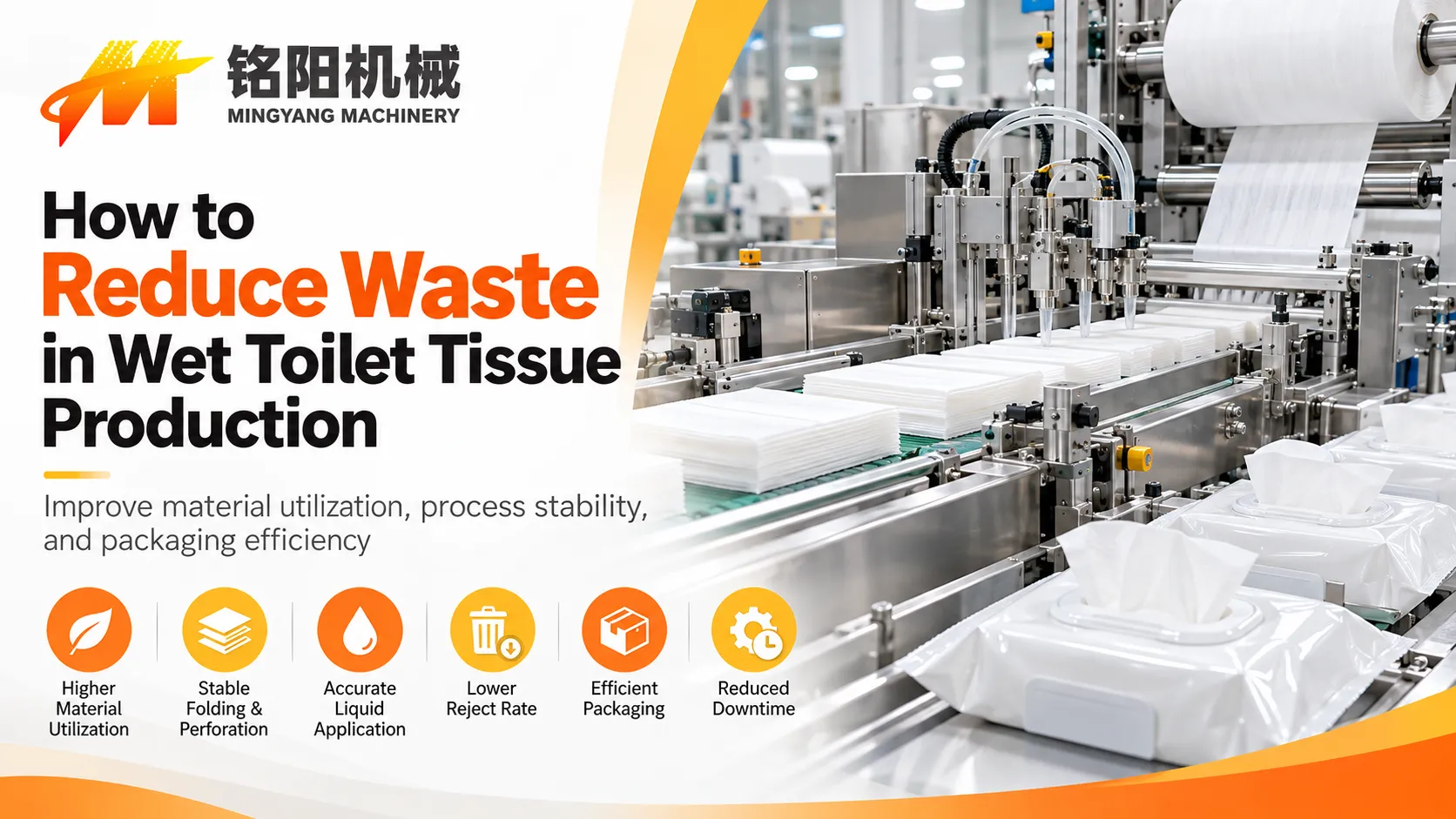
Reducing waste is one of the most effective ways to improve wet toilet tissue manufacturing profitability. However, waste does not only come from raw materials. It can also come from unstable processes, excessive liquid usage, rejected products, packaging losses, and unexpected machine downtime.
A faster production line does not always mean lower manufacturing costs.
If a machine produces more packs but also creates higher rejection rates, more material waste, and more adjustment time, the actual production cost may increase.
For wet toilet tissue manufacturers, the real goal is:
More Qualified Products + Less Waste + Stable Production
Waste reduction should therefore focus on the complete production process:
Raw Material → Folding & Perforation → Liquid Application → Cutting → Packaging → Finished Product Inspection
By identifying where waste occurs and improving process stability, manufacturers can reduce unnecessary losses while maintaining product quality.
Identify the Main Sources of Waste in Wet Toilet Tissue Production
The first step to reducing waste is understanding where losses occur throughout the manufacturing process.
Different production stages create different types of waste.
| Waste Source | Common Causes |
|---|---|
| Raw Material Waste | Material damage, unstable feeding, incorrect adjustment |
| Folding Waste | Misalignment, unstable stacking, product defects |
| Perforation Waste | Poor sheet connection, dispensing problems |
| Liquid Waste | Excessive dosage, uneven application |
| Packaging Waste | Film errors, sealing problems, incorrect settings |
| Reject Products | Weight variation, moisture issues, poor dispensing |
| Downtime Waste | Machine stops, repeated adjustments, production delays |
Each type of waste requires a different solution.
Reducing waste is therefore not about one single machine setting. It requires improving the stability of the complete production system.
Reduce Nonwoven Material Waste
Stable material feeding and process control help manufacturers maximize nonwoven utilization and reduce unnecessary raw material loss.
Nonwoven material is one of the major cost components in wet toilet tissue production, so reducing material waste can directly improve manufacturing profitability.
Common causes of material waste include:
- Unstable material feeding
- Roll alignment problems
- Material damage during production
- Incorrect machine adjustment
- Excessive trimming
A stable production process should ensure that the material moves smoothly through the line without unnecessary interruption or damage.
Manufacturers should pay attention to:
- Material feeding consistency
- Roll tension control
- Edge alignment
- Material handling during production
However, reducing material waste does not mean simply choosing the cheapest material.
A lower-cost material may create additional waste if it causes:
- Folding instability
- Higher reject rates
- Poor dispensing performance
- More production adjustments
The objective is:
Better Material Utilization + Stable Product Performance
Improve Folding and Perforation Stability
Stable folding and perforation reduce defective sheets and prevent waste caused by inconsistent product structure.
For wet toilet tissue, folding and perforation are closely related to the final dispensing experience.
The sheet connection needs to achieve a balance:
Strong Enough to Bring Out the Next Sheet + Easy Enough to Separate During Use
If folding becomes unstable, it can create:
- Uneven stacks
- Incorrect sheet positioning
- Cutting problems
- Packaging difficulties
- Finished-product defects
If perforation is inconsistent, it may cause:
- Sheets separating too early
- Poor next-sheet presentation
- Multiple sheets being pulled out
- Unstable dispensing performance
Therefore, manufacturers should focus on maintaining:
Stable Folding + Controlled Perforation → Less Production Waste
The goal is not only producing sheets faster, but producing sheets with consistent structure throughout continuous production.
Control Liquid Application to Reduce Waste
Accurate liquid application helps reduce excessive liquid consumption and prevents moisture-related product defects.
Wet toilet tissue production requires precise control of liquid quantity and distribution.
Too much liquid can create several problems:
- Higher lotion consumption
- Increased pack weight
- Packaging difficulties
- Product inconsistency
Too little liquid may affect:
- Product softness
- User experience
- Moisture expectations
However, liquid waste is not only about the total amount applied.
Another important factor is distribution.
A product may contain the correct amount of liquid but still have uneven moisture inside the stack.
This can result in:
- Dry areas
- Over-wet areas
- Inconsistent product performance
Therefore:
Correct Liquid Quantity ≠ Uniform Liquid Distribution
Manufacturers should focus on stable dosing and consistent moisture distribution rather than simply increasing liquid volume.
Reduce Reject Products Through Process Control
Preventing defects during production is more effective than discovering problems after finished products are completed.
The later a defect is discovered, the higher the waste cost.
For example:
A material problem discovered before production creates limited loss.
A packaging problem discovered after liquid application and final packing creates much higher loss.
Common reasons for rejected wet toilet tissue packs include:
- Incorrect sheet count
- Uneven moisture
- Unstable dispensing
- Incorrect pack weight
- Damaged packaging
- Leakage problems
Manufacturers should establish inspection points throughout production instead of relying only on final inspection.
A stable process helps identify problems earlier:
Material Stage → Process Stage → Finished Product Stage
The earlier the problem is detected, the lower the waste.
Optimize Packaging Material Usage
Efficient packaging control reduces film waste, sealing defects, and unnecessary material consumption.
Packaging is often considered only the final step, but packaging problems can create significant production losses.
Common packaging waste includes:
- Incorrect film feeding
- Poor sealing
- Label errors
- Package damage
- Incorrect package dimensions
Manufacturers should control:
- Packaging material specifications
- Film feeding accuracy
- Sealing temperature
- Package alignment
- Machine settings
The packaging system should match the finished wet toilet tissue structure.
An incorrect opening, package size, or sealing process can affect not only material usage but also the final dispensing experience.
The goal is:
Protect Product Quality While Minimizing Packaging Loss
Reduce Waste Caused by Machine Downtime
Unplanned downtime creates hidden waste by consuming labor, materials, and production capacity.
Many manufacturers focus only on physical material waste, but downtime is another important production loss.
During machine stops, manufacturers may lose:
- Production time
- Labor efficiency
- Adjustment materials
- Trial products after restarting
Common causes include:
- Incorrect machine settings
- Material replacement
- Sensor issues
- Lack of maintenance
- Frequent parameter adjustment
To reduce downtime waste, manufacturers can improve:
- Preventive maintenance
- Operator training
- Production parameter records
- Spare parts preparation
- Standard operating procedures
A stable machine is not only faster. It also produces fewer unnecessary losses.
Use Production Data to Monitor Waste
Manufacturers can reduce waste more effectively by tracking production data instead of relying only on operator experience.
Important production indicators include:
| KPI | Purpose |
|---|---|
| Material Waste Rate | Measure raw material utilization |
| Reject Rate | Identify product quality issues |
| Liquid Consumption | Control liquid cost |
| Downtime | Improve production stability |
| Packaging Waste | Reduce packaging losses |
| Rework Rate | Identify repeated process problems |
Without data, manufacturers may know that waste exists but not understand where it comes from.
Production records help identify:
- Which process creates the most waste
- When problems happen
- Whether adjustments are effective
- How to improve long-term stability
Balance Waste Reduction and Product Quality
Waste reduction should never compromise the final product experience.
Some cost-saving approaches may create bigger problems if they reduce product quality.
For example:
Using a cheaper material may increase:
- Product defects
- Machine adjustments
- Customer complaints
Reducing liquid too much may affect:
- Product feel
- Moisture performance
Reducing packaging quality may affect:
- Moisture protection
- Dispensing experience
Manufacturers should focus on:
Lowest Total Production Cost, Not Lowest Individual Cost
The real manufacturing cost includes:
Material Cost + Waste + Reject Cost + Labor + Downtime
A stable production process often creates greater savings than simply reducing individual material costs.
Waste Reduction Checklist for Wet Toilet Tissue Manufacturers
A systematic checklist helps manufacturers identify improvement opportunities across the complete production process.
| Area | Improvement Focus |
|---|---|
| Material | Reduce feeding loss and material damage |
| Folding | Maintain stable alignment and stacking |
| Perforation | Ensure consistent sheet connection |
| Liquid | Control dosage and moisture distribution |
| Counting | Prevent incorrect sheet quantities |
| Packaging | Reduce film and sealing waste |
| Maintenance | Prevent unexpected downtime |
| Data | Track production performance continuously |
Waste reduction should become part of daily production management rather than a one-time improvement project.
Conclusion
Reducing waste in wet toilet tissue production requires controlling the complete manufacturing system, not focusing on only one production stage.
The most effective improvements usually come from multiple small optimizations:
**Better Material Utilization
- Stable Folding
- Controlled Perforation
- Accurate Liquid Application
- Lower Reject Rate
- Efficient Packaging
- Reduced Downtime**
Together, these improvements help manufacturers reduce unnecessary losses while maintaining product quality.
For wet toilet tissue manufacturers, the best production line is not only the one that runs quickly.
It is the one that can consistently produce qualified products with stable performance and minimal waste.