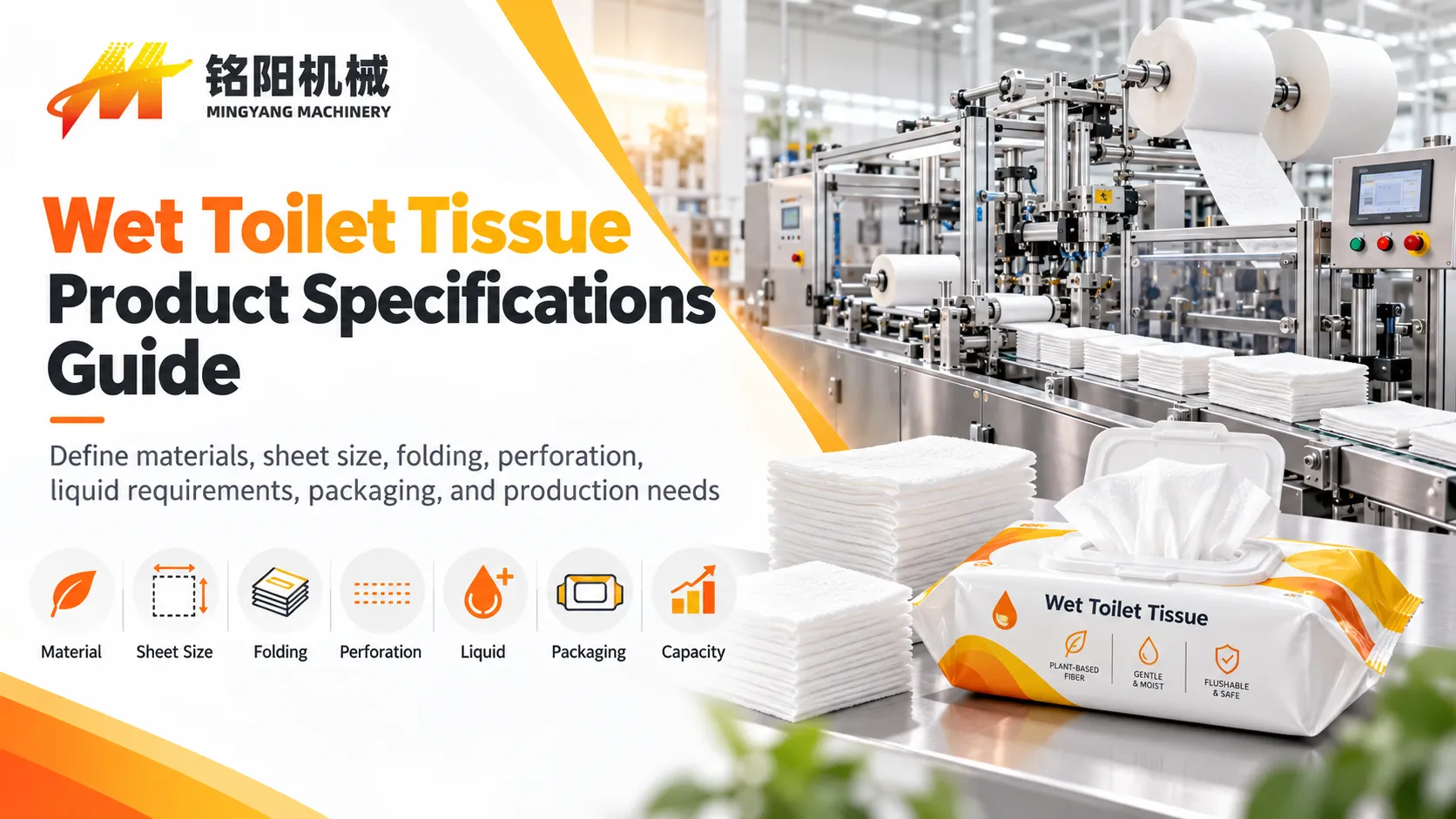
Before investing in a wet toilet tissue production line, manufacturers should first define the product specifications. These specifications determine the required materials, folding structure, liquid application method, packaging format, and machine configuration.
Many manufacturers focus first on machine speed, production capacity, or equipment price. However, the production line should always be designed around the final product requirements.
A wet toilet tissue product is not defined by the machine alone. Its final performance depends on many connected factors:
Material → Sheet Size → Folding → Perforation → Liquid Application → Packaging → Dispensing Performance
Clear product specifications help manufacturers select the right production process, avoid unnecessary equipment adjustments, and build a more stable manufacturing system.
Why Product Specifications Matter Before Production
Clear product specifications help manufacturers choose the correct production process and avoid costly changes after equipment investment.
Different wet toilet tissue products may look similar to consumers, but their manufacturing requirements can be very different.
For example, products may vary in:
- Sheet size
- Number of sheets per pack
- Folding structure
- Moisture level
- Packaging format
- Dispensing requirements
- Production capacity
These differences directly affect:
- Folding system design
- Cutting requirements
- Liquid application method
- Packaging equipment
- Production efficiency
Without clear product specifications, manufacturers may select equipment first and discover later that additional adjustments are required.
The correct development process should be:
Product Specification → Process Requirement → Machine Configuration
Define the Wet Toilet Tissue Material Requirements
Material selection is one of the first product specifications manufacturers should define because it affects softness, strength, absorption, and dispensing performance.
The material should be selected according to the expected product performance, not only based on supplier availability or material price.
Important material specifications include:
- Fiber composition
- GSM
- Wet strength
- Absorption performance
- Softness requirement
- Dispersibility requirement (if applicable)
Different product positioning may require different material characteristics.
For example, a product designed for a premium bathroom experience may prioritize softness and user comfort.
A product designed for flushable applications may require additional consideration of material structure and dispersibility.
However, manufacturers should remember:
A specific material property alone does not define the final product performance.
The material must also work together with folding, perforation, liquid application, and packaging design.
Define Sheet Size and Folded Dimensions
Sheet size and folded dimensions directly affect product appearance, pack size, material usage, and machine configuration.
Before production, manufacturers should define both the unfolded sheet size and the final folded size.
Unfolded Sheet Size
The unfolded sheet dimensions affect:
- User experience
- Material consumption
- Product positioning
- Production planning
A larger sheet may provide greater coverage during use, but it also increases material consumption and may affect the final package size.
A smaller sheet may reduce material usage but could change the expected user experience.
Folded Sheet Size
The folded dimensions affect:
- Stack height
- Package dimensions
- Folding system requirements
- Dispensing performance
For pull-out wet toilet tissue, folded size is especially important because the folded structure influences how the sheets present during use.
The product specification should therefore define:
Unfolded Size + Folding Method + Final Folded Size
before production begins.
Define Sheets Per Pack and Product Weight
Sheet count and finished pack weight are important specifications that influence packaging, production planning, and cost control.
Manufacturers should define:
- Sheets per pack
- Target pack weight
- Acceptable weight variation
The number of sheets affects:
- Stack height
- Package dimensions
- Cutting requirements
- Production speed
Finished pack weight is influenced by several factors:
- Material weight
- Sheet count
- Liquid quantity
- Packaging material
A clear weight specification helps manufacturers maintain consistency between different production batches.
However, weight should not be considered separately from product performance.
A product with the correct weight still needs to provide:
- Stable moisture
- Reliable dispensing
- Consistent sheet separation
Define Folding and Perforation Requirements
Folding and perforation specifications determine how the final product performs during dispensing.
For wet toilet tissue with pull-out dispensing, manufacturers need to define how sheets should connect and separate.
Important considerations include:
- Folding style
- Sheet connection structure
- Perforation design
- Separation performance
The objective is:
Pull One Sheet → Bring Out the Next Sheet → Easy Separation
The perforation should provide enough connection strength to bring the next sheet into position while allowing the current sheet to separate easily.
The folding structure also needs to remain stable so that the product performs consistently throughout the package.
This means folding and perforation should not be treated as independent specifications.
They are part of the complete dispensing system:
Material Properties + Folding Structure + Perforation Design → Dispensing Performance
Define Liquid Application Requirements
Liquid requirements affect moisture level, product feel, pack weight, and production process design.
Manufacturers should define:
- Target moisture level
- Liquid type
- Required liquid distribution
- Finished product feel
The liquid application method must match the product requirements.
Depending on the production design, liquid may be applied:
- During folding
- Before cutting
- After cutting
- Through pre-wetting combined with secondary liquid application
However, the goal is not simply applying more liquid.
The key requirement is:
Correct Liquid Quantity + Consistent Liquid Distribution
Uneven moisture can affect:
- Product quality
- Pack weight consistency
- User experience
- Dispensing performance
Therefore, liquid requirements should be defined before selecting the production configuration.
Define Packaging Specifications
Packaging specifications influence product protection, appearance, dispensing experience, and production equipment selection.
Manufacturers should define:
- Soft pack or pre-made bag
- With lid or without lid
- Package dimensions
- Opening design
- Label requirements
- Sealing requirements
For wet toilet tissue, packaging is closely connected with product performance.
The opening size and position should match:
- Sheet dimensions
- Folding structure
- Stack height
- Dispensing method
A well-designed package should provide:
Moisture Protection + Easy Dispensing + Reliable Product Storage
The relationship can be summarized as:
Tissue Structure + Packaging Design = User Experience
Define Production Capacity and Market Requirements
Production capacity should be defined together with product specifications because it affects machine configuration and automation requirements.
Manufacturers should consider:
- Target output
- Working hours
- Market demand
- Product variety
- Packaging format
- Automation level
A factory producing multiple product specifications may need more flexibility.
A factory focusing on high-volume production may prioritize higher automation and continuous production stability.
The production line should therefore match both:
Product Requirements + Business Requirements
Wet Toilet Tissue Product Specification Checklist
A clear product specification checklist helps manufacturers communicate requirements before equipment selection and production planning.
| Specification | What Manufacturers Need to Define |
|---|---|
| Material | Fiber, GSM, wet strength, absorption |
| Sheet Size | Length and width of the tissue |
| Folded Size | Final folded dimensions |
| Sheet Count | Number of sheets per pack |
| Folding | Folding structure and method |
| Perforation | Connection and separation requirements |
| Liquid | Moisture level and distribution requirements |
| Packaging | Bag type, opening and lid design |
| Capacity | Required production output |
| Quality | Dispensing and finished-product expectations |
This specification document can become the foundation for product development, machine selection, and production planning.
How Product Specifications Affect Machine Configuration
The production line should be designed around the product specification, not the other way around.
Product specifications influence many equipment decisions, including:
- Folding width
- Cutting system
- Counting method
- Liquid application system
- Packaging method
- Automation level
For example, different sheet sizes and folding structures may require different folding configurations.
Different packaging requirements may influence whether a manufacturer chooses roll-film packaging or pre-made bag packaging.
Different moisture requirements may affect the liquid application system.
The correct approach is:
Define the Product First → Design the Production Process → Select the Equipment Configuration
This reduces unnecessary modifications and helps manufacturers achieve more stable production.
Conclusion
Defining wet toilet tissue product specifications before production helps manufacturers reduce investment risks and build a production line that matches their actual product goals.
A complete product specification should define:
**Material
- Sheet Size
- Folding
- Perforation
- Liquid Requirements
- Packaging
- Production Capacity**
These specifications determine the required manufacturing process and equipment configuration.
For wet toilet tissue manufacturers, the most important question is not only:
“Which machine should we buy?”
The better question is:
“What product do we want to manufacture, and what production requirements does that product create?”
Once the product specifications are clearly defined, manufacturers can select more suitable processes, reduce unnecessary adjustments, and create a more stable path from product development to mass production.